DSharp.fi
  • Home
  • Solutions
    • DSharp PathFinder
    • DSharp Studio
    • DSharp Studio Modeler
    • Pricing and Licenses
  • Services
    • Professional services
    • DSharp Training Program and Certifications
    • Developer Support
  • Customers
    • Our Customers
    • Customer Success Stories
      • Pirte’s Data Platform Modernization Boosts Data-Driven Healthcare
      • A City Expanded Its Data Warehouse with Library Data
      • Varha – a wellbeing services county – built a data-driven management system
      • From Double Checks to Smooth Automation – DSharp Studio Simplified Early Childhood Education Data Management
      • Productivity Leap improved Metsähallitus’ data management with DSharp Studio
  • Partners
    • Our Partners
    • Partner Stories
    • Become a Partner
  • Resources
  • Articles
    • Data warehousing
      • Data Warehouse concepts and data models
      • DSharp Studio Release: Extended Data Catalog and New Find Command
    • Reporting automation
      • Automate data pipelines
      • Making Data Management Easier with Automation
      • Metsähallitus enhanced its data management with DSharp’s data platform tool
    • Data modeling and mapping
      • Data Warehouse concepts and data models
      • Data vs Business Driven Modeling
  • About
    • About us
    • Contact us
    • Recruiting
  • Book a Demo
  • Start a Trial
  • Menu Menu
  • Features
    • DSharp Studio Features
    • DSharp Studio Modeler Features
    • Command Reference
    • Release Notes
    • Installation Guide
  • Modeling
    • Design Considerations
      • Data vs Business Driven Modeling
      • The Business Key
    • Basics
      • Model Types
      • Archetypes
      • Datatypes
    • Raw Model
      • Source Mappings
      • Metadata
    • Business Model
      • Metadata
  • Course Material
    • DSharp Studio Professional Course
    • DSharp Studio Expert Course
  • Legacy
    • DSharp Engine Features
      • Mapping Source Data in DSharp Engine
    • DSharp Engine Command Reference
    • DSharp Engine Installation Guide
    • 3rd Party Modeling Tools
      • Visual Paradigm
        • Modeling With Visual Paradigm
        • Configuring Data Vault 2.0 And Servers
        • Implementing Mappings
        • Setting Up
          • Import Stereotypes
          • Configure UI
      • Ellie
        • Modeling With Ellie
        • Ellie Metadata
    • Course Material
      • Intro Course
      • Advanced Course
  • Community
  • FAQ

What We Learn

We see what kind of changes are required when a flat hierarchy gets a new level.

Scenario

Continuing on the last tutorial, OrgMaster Pro now publishes a structure that is one level deeper than previously. We will make the necessary changes to all three previous implementations.

Our data now looks like this:
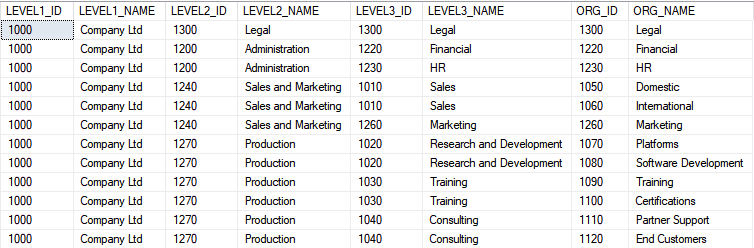
  • the new level is LEVEL3_ID/LEVEL3_NAME
  • some elements exist in several levels:
    • 1220 Financial
    • 1230 HR
    • 1260 Marketing
    • 1300 Legal

Modeling

The three target structures look like this, with level 3 that has snuck in between the organisation unit and level 2:
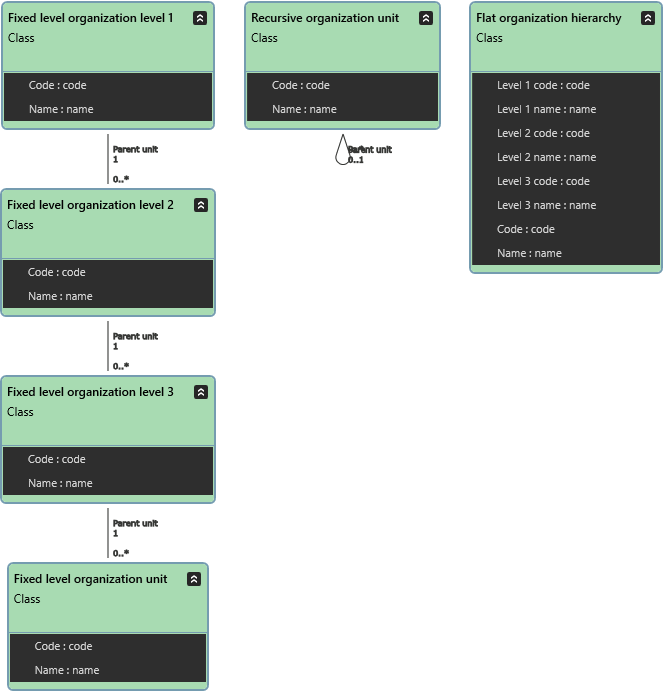
With the following details:

do this… …and this will happen

In Fixed level organisation level 3, set Code to Business key

This will still work.

Mapping

The basic rules for mapping to these structures are like follows:

  • Mapping to the 1:1 flat structure is still trivial, no alias
  • In the fixed level as well as the recursive case, add a new aliased mapping set symmetrical to the existing ones
  • In both, remap the lowest organisation unit level to the new next-to-last level
  • Using where-clauses, only load the first (highest level) of those units that repeat on consecutive levels

So the mappings will look like this (changes and additions indicated by the red frames):

Refresh and Inspect

Refresh D♯ Engine with the current model export and mappings. Use the D♯ Engine UI to compare the target structures to understand their differences (ignoring administrative tables):

  • The flat structure got two more columns into its existing satellite
  • The fixed level structure got one new hub/satellite/link set
  • The recursive structure got one new satellite

Deploy the Changes And Try It Out

Deploy the new classes and run the test script.

Script Source data Main points of interest
Step 1: Reload organization data A flat organisation hierarchy one level deeper and with repeating elements The structural changes.

Also, the recursive structure is actually the only structure that stores the correct hierarchy information as it truly is, without repeating dummy elements. Repeating elements only exist in the data in order to fix the ragged hierarchy so that the data works in a reporting context. The original flat hierarchy is not the correct representation for the actual hierarchy.

Next tutorial

  • Developer Content
    • No Access
    • Model Types
    • Archetypes
    • Datatypes
    • Source Mappings
    • Metadata
    • Metadata
    • Data vs Business Driven Modeling
    • The Business Key
    • DSharp Studio Professional Course
      • Tutorial 01: Person Tutorial
      • Tutorial 02: Add Attributes
      • Tutorial 03: Project Tutorial
      • Tutorial 04: Hash Error Handling
      • Tutorial 05: Simple Hierarchy
      • Tutorial 06: Transactions
      • Tutorial 07: Filtering Data
      • Tutorial 08: Loading Multiple Classes From One Source
      • Tutorial 09: Handling Legitimate Duplicates
      • Tutorial 10: Multiple Attribute Values
    • Intro Course
      • Intro Course – Before You Begin
      • Tutorial 01 – Visual Paradigm
      • Tutorial 01 – Ellie
      • Tutorial 01: Person Tutorial
      • Tutorial 02: Add Attributes
      • Tutorial 03: Project Tutorial
      • Tutorial 04: Hash Error Handling
      • Tutorial 05: Simple Hierarchy
      • Tutorial 06: Transactions
      • Tutorial 07: Changing Load Behaviour
      • Tutorial 08: Loading Multiple Classes From One Source
      • Tutorial 09: Handling Legitimate Duplicates
      • Tutorial 10: Multiple Attribute Values
    • Advanced BDP Developer Course
      • Tutorial 01: Key Groups
      • Tutorial 02: Implementing the Participation Design Pattern
      • Tutorial 03: Versioned Source Data
      • Tutorial 04: Advanced State Handling
      • Tutorial 05: Hierarchy Alternatives
      • Tutorial 06: Hierarchy Depth Changes
      • Tutorial 07: Partial Load Deletion Detection
      • Tutorial 08: Merge Hashes Non-Destructively
      • Tutorial 09: Implementing Business Objects
      • Tutorial 10: Custom Value Transformations
    • DSharp Studio Expert Course
      • Tutorial 01: Key Groups
      • Tutorial 02: Implementing the Participation Design Pattern
      • Tutorial 03: Versioned Source Data
      • Tutorial 04: Advanced State Handling
      • Tutorial 05: Hierarchy Alternatives
      • Tutorial 06: Hierarchy Depth Changes
      • Tutorial 07: Partial Load Deletion Detection
      • Tutorial 08: Merge Hashes Non-Destructively
      • Tutorial 09: Derived Classes
    • Mapping Source Data
    • Command Reference
    • Release Notes And Downloads
    • DSharp Studio Command Reference
    • DSharp Studio Command Reference
    • DSharp Studio Features
    • DSharp Studio Modeler Features
    • DSharp Studio Modeler Installation Guide
    • Installation Guide
    • Configuring Data Vault 2.0 And Servers
    • Modeling With Visual Paradigm
    • Implementing Mappings
    • Import Stereotypes
    • Configure Visual Paradigm UI
    • Modeling With Ellie
    • Ellie Metadata
  • Frequently Asked Questions

Finland
Yliopistonkatu 31, 20100, Turku
Bertel Jungin aukio 5, 02600 Espoo

Germany
Podbielskistrasse 333,
5th floor, 30659, Hannover

Solutions

  • DSharp Studio
  • DSharp Studio Modeler
  • Pricing and Licenses

FAQ

  • About us
  • Contact us
  • Recruiting

Legal

  • Privacy policy
  • DSharp Studio License Subscription Agreement

Contact us!

    © Copyright DSharp Oy
    • Link to LinkedIn
    • Link to Mail
    Scroll to top Scroll to top Scroll to top