DSharp.fi
  • Home
  • Solutions
    • DSharp PathFinder
    • DSharp Studio
    • DSharp Studio Modeler
    • Pricing and Licenses
  • Services
    • Professional services
    • DSharp Training Program and Certifications
    • Developer Support
  • Customers
    • Our Customers
    • Customer Success Stories
      • Pirte’s Data Platform Modernization Boosts Data-Driven Healthcare
      • A City Expanded Its Data Warehouse with Library Data
      • Varha – a wellbeing services county – built a data-driven management system
      • From Double Checks to Smooth Automation – DSharp Studio Simplified Early Childhood Education Data Management
      • Productivity Leap improved Metsähallitus’ data management with DSharp Studio
  • Partners
    • Our Partners
    • Partner Stories
    • Become a Partner
  • Resources
  • Articles
    • Data warehousing
      • Data Warehouse concepts and data models
      • DSharp Studio Release: Extended Data Catalog and New Find Command
    • Reporting automation
      • Automate data pipelines
      • Making Data Management Easier with Automation
      • Metsähallitus enhanced its data management with DSharp’s data platform tool
    • Data modeling and mapping
      • Data Warehouse concepts and data models
      • Data vs Business Driven Modeling
  • About
    • About us
    • Contact us
    • Recruiting
  • Book a Demo
  • Start a Trial
  • Menu Menu
  • Features
    • DSharp Studio Features
    • DSharp Studio Modeler Features
    • Command Reference
    • Release Notes
    • Installation Guide
  • Modeling
    • Design Considerations
      • Data vs Business Driven Modeling
      • The Business Key
    • Basics
      • Model Types
      • Archetypes
      • Datatypes
    • Raw Model
      • Source Mappings
      • Metadata
    • Business Model
      • Metadata
  • Course Material
    • DSharp Studio Professional Course
    • DSharp Studio Expert Course
  • Legacy
    • DSharp Engine Features
      • Mapping Source Data in DSharp Engine
    • DSharp Engine Command Reference
    • DSharp Engine Installation Guide
    • 3rd Party Modeling Tools
      • Visual Paradigm
        • Modeling With Visual Paradigm
        • Configuring Data Vault 2.0 And Servers
        • Implementing Mappings
        • Setting Up
          • Import Stereotypes
          • Configure UI
      • Ellie
        • Modeling With Ellie
        • Ellie Metadata
    • Course Material
      • Intro Course
      • Advanced Course
  • Community
  • FAQ

Tutorial 07 – Partial Load Deletion Detection

What We Learn

We can automatically apply a source-aware algorithm for deletion detection to mark data as deleted.

Scenario

We want to start soft deleting Projects. In a full load situation where we possibly load the same class from several source systems, we can activate the enhanced deletion detection mechanism by only setting the corresponding parameter to true for the class for which we want to activate the algorithm.

In short, if State tracking has been turned on:

  • Algorithm off: “Don’t mark any class’ hashes as deleted if any source system for that class has zero rows to load in this batch. If all sources have some data to be loaded, mark all hashes as deleted that are missing from all of the source material”
  • Algorithm on: “Mark those hashes as deleted that don’t exist in any source that the hash has been loaded from before, but not those that only come from sources that have zero rows to load in this batch”

Modeling

Soft delete requires the State tracking to be turned on for the class we want to apply Soft delete to. We’ll just do this:

do this… …and this will happen

For the Project class, check the Track state parameter value.

The loading mechanism will start tracking how previously loaded hashes disappear and reappear in the source data.

Run the Model And Deploy the Changes

Deploy the Project class, then run the test scripts.

The deletion detection parameter is set like this, when required:
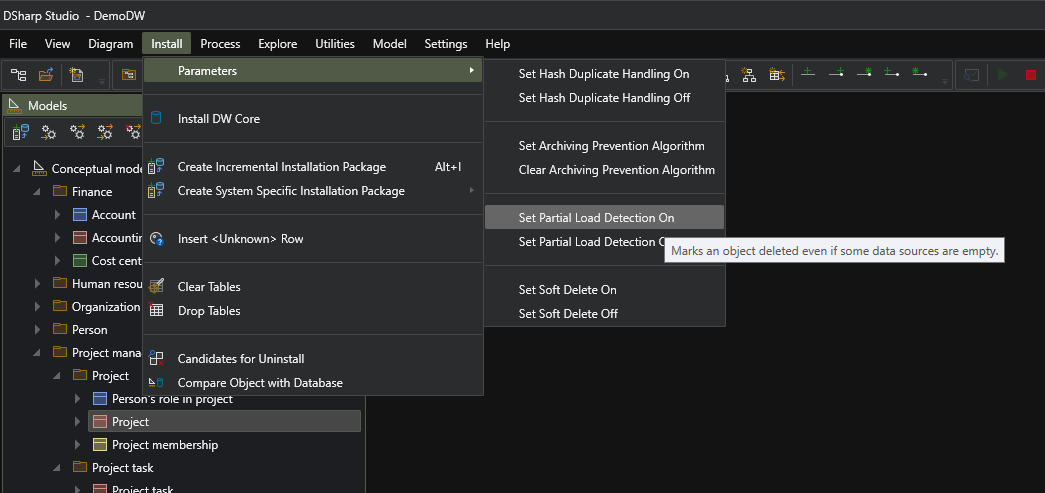
Script Source data Main points of interest
Step 1: Load all sources
Projects from all three sources 6 projects in total being loaded.
Step 2: Omit one source system from load
One source not loaded Initially, unchanged content due to delete detection not turned on. After turning on the detection, the new load of the same material correctly soft deleted an item that was never loaded from the missing source.
Step 3: Only load one source
Loaded only from one source Successful soft delete of item that was missing from the one loaded source. The item had not been loaded  from any other source previously.
Step 4: Load several changes
Load changed, added and deleted data from all sources Project missing from one source that is the only source it has been loaded from is successfully soft deleted.

Next tutorial

  • Developer Content
    • No Access
    • Model Types
    • Archetypes
    • Datatypes
    • Source Mappings
    • Metadata
    • Metadata
    • Data vs Business Driven Modeling
    • The Business Key
    • DSharp Studio Professional Course
      • Tutorial 01: Person Tutorial
      • Tutorial 02: Add Attributes
      • Tutorial 03: Project Tutorial
      • Tutorial 04: Hash Error Handling
      • Tutorial 05: Simple Hierarchy
      • Tutorial 06: Transactions
      • Tutorial 07: Filtering Data
      • Tutorial 08: Loading Multiple Classes From One Source
      • Tutorial 09: Handling Legitimate Duplicates
      • Tutorial 10: Multiple Attribute Values
    • Intro Course
      • Intro Course – Before You Begin
      • Tutorial 01 – Visual Paradigm
      • Tutorial 01 – Ellie
      • Tutorial 01: Person Tutorial
      • Tutorial 02: Add Attributes
      • Tutorial 03: Project Tutorial
      • Tutorial 04: Hash Error Handling
      • Tutorial 05: Simple Hierarchy
      • Tutorial 06: Transactions
      • Tutorial 07: Changing Load Behaviour
      • Tutorial 08: Loading Multiple Classes From One Source
      • Tutorial 09: Handling Legitimate Duplicates
      • Tutorial 10: Multiple Attribute Values
    • Advanced BDP Developer Course
      • Tutorial 01: Key Groups
      • Tutorial 02: Implementing the Participation Design Pattern
      • Tutorial 03: Versioned Source Data
      • Tutorial 04: Advanced State Handling
      • Tutorial 05: Hierarchy Alternatives
      • Tutorial 06: Hierarchy Depth Changes
      • Tutorial 07: Partial Load Deletion Detection
      • Tutorial 08: Merge Hashes Non-Destructively
      • Tutorial 09: Implementing Business Objects
      • Tutorial 10: Custom Value Transformations
    • DSharp Studio Expert Course
      • Tutorial 01: Key Groups
      • Tutorial 02: Implementing the Participation Design Pattern
      • Tutorial 03: Versioned Source Data
      • Tutorial 04: Advanced State Handling
      • Tutorial 05: Hierarchy Alternatives
      • Tutorial 06: Hierarchy Depth Changes
      • Tutorial 07: Partial Load Deletion Detection
      • Tutorial 08: Merge Hashes Non-Destructively
      • Tutorial 09: Derived Classes
    • Mapping Source Data
    • Command Reference
    • Release Notes And Downloads
    • DSharp Studio Command Reference
    • DSharp Studio Command Reference
    • DSharp Studio Features
    • DSharp Studio Modeler Features
    • DSharp Studio Modeler Installation Guide
    • Installation Guide
    • Configuring Data Vault 2.0 And Servers
    • Modeling With Visual Paradigm
    • Implementing Mappings
    • Import Stereotypes
    • Configure Visual Paradigm UI
    • Modeling With Ellie
    • Ellie Metadata
  • Frequently Asked Questions

Finland
Yliopistonkatu 31, 20100, Turku
Bertel Jungin aukio 5, 02600 Espoo

Germany
Podbielskistrasse 333,
5th floor, 30659, Hannover

Solutions

  • DSharp Studio
  • DSharp Studio Modeler
  • Pricing and Licenses

FAQ

  • About us
  • Contact us
  • Recruiting

Legal

  • Privacy policy
  • DSharp Studio License Subscription Agreement

Contact us!

    © Copyright DSharp Oy
    • Link to LinkedIn
    • Link to Mail
    Scroll to top Scroll to top Scroll to top