DSharp.fi
  • Home
  • Solutions
    • DSharp PathFinder
    • DSharp Studio
    • DSharp Studio Modeler
    • Pricing and Licenses
  • Services
    • Professional services
    • DSharp Training Program and Certifications
    • Developer Support
  • Customers
    • Our Customers
    • Customer Success Stories
      • Pirte’s Data Platform Modernization Boosts Data-Driven Healthcare
      • A City Expanded Its Data Warehouse with Library Data
      • Varha – a wellbeing services county – built a data-driven management system
      • From Double Checks to Smooth Automation – DSharp Studio Simplified Early Childhood Education Data Management
      • Productivity Leap improved Metsähallitus’ data management with DSharp Studio
  • Partners
    • Our Partners
    • Partner Stories
    • Become a Partner
  • Resources
  • Articles
    • Data warehousing
      • Data Warehouse concepts and data models
      • DSharp Studio Release: Extended Data Catalog and New Find Command
    • Reporting automation
      • Automate data pipelines
      • Making Data Management Easier with Automation
      • Metsähallitus enhanced its data management with DSharp’s data platform tool
    • Data modeling and mapping
      • Data Warehouse concepts and data models
      • Data vs Business Driven Modeling
  • About
    • About us
    • Contact us
    • Recruiting
  • Book a Demo
  • Start a Trial
  • Menu Menu
  • Features
    • DSharp Studio Features
    • DSharp Studio Modeler Features
    • Command Reference
    • Release Notes
    • Installation Guide
  • Modeling
    • Design Considerations
      • Data vs Business Driven Modeling
      • The Business Key
    • Basics
      • Model Types
      • Archetypes
      • Datatypes
    • Raw Model
      • Source Mappings
      • Metadata
    • Business Model
      • Metadata
  • Course Material
    • DSharp Studio Professional Course
    • DSharp Studio Expert Course
  • Legacy
    • DSharp Engine Features
      • Mapping Source Data in DSharp Engine
    • DSharp Engine Command Reference
    • DSharp Engine Installation Guide
    • 3rd Party Modeling Tools
      • Visual Paradigm
        • Modeling With Visual Paradigm
        • Configuring Data Vault 2.0 And Servers
        • Implementing Mappings
        • Setting Up
          • Import Stereotypes
          • Configure UI
      • Ellie
        • Modeling With Ellie
        • Ellie Metadata
    • Course Material
      • Intro Course
      • Advanced Course
  • Community
  • FAQ

Getting Started With Modeling

Basic Modeling Tips

Ellie is based on Models. In a model, you can have several Entities connected to each other using Relations. Each entity, when created, becomes a part of the Glossary. An entity can be reused in other models by adding it to the model from the Glossary.

Here are some tips to get you up & running with Ellie as required by the tutorials:

  • to keep the Raw Model entities and Business Model entities separated, use an appropriate naming convention for the models, for example the prefix RM or BM for Raw Model and Business Model, respectively
  • to further separate and identify models describing different source systems, you can include the source name in the model name
  • make readable models by keeping the amount of entities reasonable: one model should be readable when printed on paper
  • datatypes to be used for attributes can be found here

Metadata

Entity Metadata

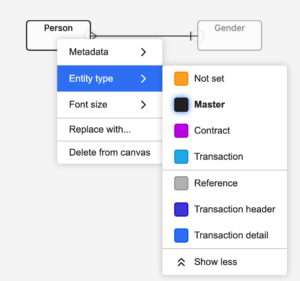
Ellie supports Entity types which roughly correspond to the Archetypes used in D♯ Engine. After having created the Entity in Ellie, assign the correct Entity type according to this table:

For Archetype… …select Ellie Type
Party, Place, Thing Master
Moment – Interval Contract
Role Not set (leave unassigned)
Description Reference

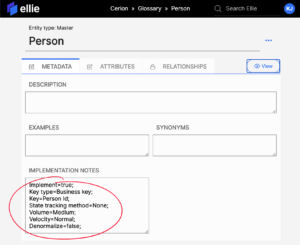
The Entity metadata is defined for the Entity by writing the metadata parameter name and value in a text box dedicated for this purpose. Entity-specific metadata is written in the Implementation Notes textbox below. The label and location of the textbox may vary depending on the individual Ellie configuration that is in use. If your configuration does not work with D♯ Engine, contact devsupport(at)dsharp.fi

Metadata values (both Entity and Attribute) should be copied to the metadata text field from here.
Attribute Metadata

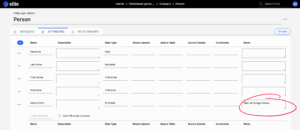
Attribute metadata is written into the Notes text box:
Relation End Metadata

Ellie does not currently support relation end metadata.

Exporting the Model

In order to make the model available for D♯ Engine, you need to export it to the working directory. Ellie produces separate .csv export files for the entities, attributes and relations. Exporting these files is done from a Report, and the files will be downloaded to your Downloads folder. From there, you should move them to your D♯ Engine project folder/working directory. Refer to the Ellie documentation how to create a report.
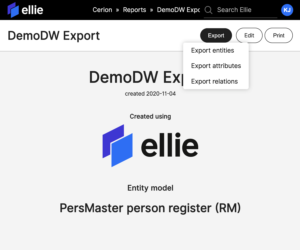
You can open the exported model with the D♯ Engine Open Ellie Model -command. Navigate to the working directory and open any of the three .csv files. D♯ Engine will process all three files. Before opening, remove any older version of the files, as otherwise the read process will create duplicates.

  • Developer Content
    • No Access
    • Model Types
    • Archetypes
    • Datatypes
    • Source Mappings
    • Metadata
    • Metadata
    • Data vs Business Driven Modeling
    • The Business Key
    • DSharp Studio Professional Course
      • Tutorial 01: Person Tutorial
      • Tutorial 02: Add Attributes
      • Tutorial 03: Project Tutorial
      • Tutorial 04: Hash Error Handling
      • Tutorial 05: Simple Hierarchy
      • Tutorial 06: Transactions
      • Tutorial 07: Filtering Data
      • Tutorial 08: Loading Multiple Classes From One Source
      • Tutorial 09: Handling Legitimate Duplicates
      • Tutorial 10: Multiple Attribute Values
    • Intro Course
      • Intro Course – Before You Begin
      • Tutorial 01 – Visual Paradigm
      • Tutorial 01 – Ellie
      • Tutorial 01: Person Tutorial
      • Tutorial 02: Add Attributes
      • Tutorial 03: Project Tutorial
      • Tutorial 04: Hash Error Handling
      • Tutorial 05: Simple Hierarchy
      • Tutorial 06: Transactions
      • Tutorial 07: Changing Load Behaviour
      • Tutorial 08: Loading Multiple Classes From One Source
      • Tutorial 09: Handling Legitimate Duplicates
      • Tutorial 10: Multiple Attribute Values
    • Advanced BDP Developer Course
      • Tutorial 01: Key Groups
      • Tutorial 02: Implementing the Participation Design Pattern
      • Tutorial 03: Versioned Source Data
      • Tutorial 04: Advanced State Handling
      • Tutorial 05: Hierarchy Alternatives
      • Tutorial 06: Hierarchy Depth Changes
      • Tutorial 07: Partial Load Deletion Detection
      • Tutorial 08: Merge Hashes Non-Destructively
      • Tutorial 09: Implementing Business Objects
      • Tutorial 10: Custom Value Transformations
    • DSharp Studio Expert Course
      • Tutorial 01: Key Groups
      • Tutorial 02: Implementing the Participation Design Pattern
      • Tutorial 03: Versioned Source Data
      • Tutorial 04: Advanced State Handling
      • Tutorial 05: Hierarchy Alternatives
      • Tutorial 06: Hierarchy Depth Changes
      • Tutorial 07: Partial Load Deletion Detection
      • Tutorial 08: Merge Hashes Non-Destructively
      • Tutorial 09: Derived Classes
    • Mapping Source Data
    • Command Reference
    • Release Notes And Downloads
    • DSharp Studio Command Reference
    • DSharp Studio Command Reference
    • DSharp Studio Features
    • DSharp Studio Modeler Features
    • DSharp Studio Modeler Installation Guide
    • Installation Guide
    • Configuring Data Vault 2.0 And Servers
    • Modeling With Visual Paradigm
    • Implementing Mappings
    • Import Stereotypes
    • Configure Visual Paradigm UI
    • Modeling With Ellie
    • Ellie Metadata
  • Frequently Asked Questions

Finland
Yliopistonkatu 31, 20100, Turku
Bertel Jungin aukio 5, 02600 Espoo

Germany
Podbielskistrasse 333,
5th floor, 30659, Hannover

Solutions

  • DSharp Studio
  • DSharp Studio Modeler
  • Pricing and Licenses

FAQ

  • About us
  • Contact us
  • Recruiting

Legal

  • Privacy policy
  • DSharp Studio License Subscription Agreement

Contact us!

    © Copyright DSharp Oy
    • Link to LinkedIn
    • Link to Mail
    Scroll to top Scroll to top Scroll to top